
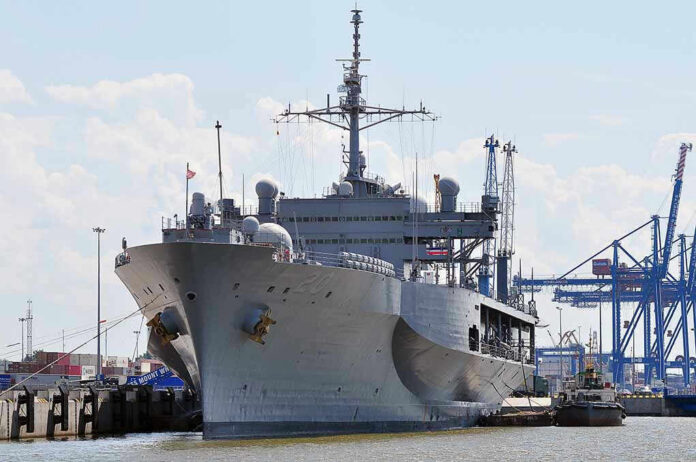
The Port Alpha shipyard proposal in Brownsville is not just another industrial project; it is a deliberate attempt to rewrite America’s role in global shipbuilding by anchoring a $3.2 billion autonomous-vessel hub on the Texas Gulf Coast.
At a Glance
- Austin-based Saronic Technologies has committed over $3.2 billion to build Port Alpha, a next‑generation autonomous shipyard at the Port of Brownsville.
- Texas and Cameron County have backed the project with an $80 million state grant and a 95% long‑term property tax abatement, betting on 10,000 new jobs and tens of billions in economic output.
- Port Alpha is designed to dramatically expand U.S. shipbuilding capacity for medium and large autonomous surface vessels, responding to both Pentagon demand and China’s overwhelming lead in commercial shipbuilding.
- The project fits a broader Texas pattern of aggressive tax‑incentive economic development, raising familiar questions about environmental impact, infrastructure strain, and who truly benefits from the boom.
A $3.2 Billion Autonomous Shipyard Anchors in Brownsville
Saronic Technologies, an Austin-based developer of autonomous surface vessels, has chosen Brownsville, Texas, as the site for Port Alpha, a shipyard that state and local officials describe as the largest autonomous vessel facility ever attempted in the United States. Announced alongside Governor Greg Abbott at Saronic’s Austin headquarters, the project carries a stated capital investment of roughly $3.2 billion to $3.248 billion, supported by an $80 million Texas Enterprise Fund grant and a $78,000 veteran hiring bonus. The facility will occupy an initial 800–835 acre footprint at the Port of Brownsville, with options to expand across more than 4,000 acres, essentially converting a significant swath of waterfront into a high-throughput, robotized shipyard.
Port Alpha’s mission is tightly bound to Saronic’s core business: medium‑ and large‑class autonomous surface vessels intended for the U.S. Navy and other government customers. The company already manufactures smaller drones such as the Spyglass, Cutlass, and Corsair at its Austin facility, and larger designs like the Marauder at a Franklin, Louisiana yard; Port Alpha is conceived as the step change that moves Saronic from boutique production into industrial-scale output. In public interviews, CEO Dino Mavrookas stresses that Port Alpha is not a speculative concept but a funded program—Saronic has raised approximately $600 million in private capital to underwrite the shipyard and its expanded product line.
On timelines, Saronic and state officials project ground-breaking in the near term and operations beginning in 2028. WorkBoat, gCaptain, and Bloomberg Tech all converge on a pattern: construction “this year” or “later this year,” followed by first ship output around 2028. Mavrookas has described the site as a greenfield build, akin to constructing an entirely new industrial complex rather than retrofitting an existing yard. Some materials, including earlier references on Saronic’s own web presence, mentioned a 2024 start, but the more recent official comments, investment announcements, and permitting activity align around a 2026 construction launch with 2028 as the operational target.
Behind the promise of infrastructure and capital sits a very clear strategic anchor: combat demand. Saronic’s unmanned vessels have already transitioned from testing to operational use, with U.S. Central Command and other defense reporting acknowledging combat deployment in the Middle East, including strikes at an Iranian naval facility and rescue support for a downed Apache helicopter crew near the Strait of Hormuz. Port Alpha is explicitly framed as the facility that will build these systems at scale.
Scaling U.S. Shipbuilding Capacity with Autonomy and Automation
To understand why Texas leaders are treating Port Alpha as a strategic asset rather than just another industrial park, you have to look at the baseline: the United States now accounts for a fraction of global shipbuilding, with China producing hundreds of commercial vessels annually while U.S. yards struggle to deliver a handful.[Port Alpha video][JfKoWdd-HE8] Saronic’s own messaging highlights stark numbers—Chinese yards building well over a thousand commercial ships in a recent year versus single-digit output in the U.S.—and points out that many American shipyards still rely on layouts and processes inherited from World War II.
Port Alpha is designed as a corrective. Phase one is planned to deliver 150,000 gross tons of shipbuilding capacity, which Saronic and Governor Abbott describe as roughly 1.5 times current U.S. commercial shipbuilding capacity.[JfKoWdd-HE8] Longer term, the company’s aspirational figures climb to 2 million gross tons—20 times today’s domestic commercial capacity—if the full expansion acreage is built out and production systems perform as envisioned.[JfKoWdd-HE8] Those are aggressive numbers and, at this stage, remain projections rather than validated engineering outputs; no public environmental impact statement or detailed technical feasibility analysis is yet available to substantiate the throughput claims.
Mechanically, Port Alpha is not just “a bigger yard.” Saronic’s concept rests on two intertwining shifts. First, autonomy allows ships to be designed without traditional crew-support infrastructure—no living quarters, smaller superstructures, and different survivability assumptions—shrinking both materials and labor requirements per hull. Second, the yard itself is meant to be heavily automated, using advanced robotics, software-defined production scheduling, and modular construction techniques to push cycle times down from years to months for certain vessel classes.[Port Alpha video]
The Franklin, Louisiana facility provides a small but telling test case. There, Saronic claims to be scaling up to produce roughly 20 Marauder vessels per year using integrated automation and modular workflows.[Port Alpha video] Port Alpha extrapolates that approach to a far larger footprint and product set, aiming to build “dozens” of ships annually and ultimately hundreds of autonomous vessels across multiple classes. Whether those extrapolations will hold at full industrial scale is precisely the sort of question a detailed engineering and capacity study would address—an analysis that has not yet been released to the public.
Jobs, Wages, and the Tax Incentive Bet
The headline political number around Port Alpha is jobs: state and local leaders consistently cite 10,000 positions tied to the shipyard, with up to 35% earmarked for local hires in Cameron County. These are not just line-operator roles. Saronic’s materials and Abbott’s remarks describe a mix that ranges from skilled trades—welders, electricians, pipefitters—to software engineers, robotics specialists, and naval architects. Abbott has publicly pegged average annual wages at around $75,000 once the facility is fully built out, implying hundreds of millions in payroll flowing into the Rio Grande Valley.
Those promises are central to the logic of the tax incentives. Cameron County commissioners have approved a 95% property tax abatement for Saronic spanning roughly 19–20 years, a package the Texas Tribune values at about $211 million in forgone revenue. That local deal sits atop the state’s $80 million Enterprise Fund grant and access to newer incentive programs targeting jobs, energy, technology, and innovation. In effect, Port Alpha’s backers are trading near-term tax relief for the long-term benefit of new employment, secondary economic activity, and Brownsville’s repositioning as a national defense-industrial node.
This structure is not unique. It fits squarely within Texas’s established Chapter 312 and 313 tax-abatement framework, which allows counties and other local entities to exempt a large share of new property value from taxation for up to a decade or more. Across the state, hundreds of such agreements have produced billions of dollars in foregone local and school district tax revenue—one statewide analysis of Chapter 313 found approximately $2.47 billion in forgone taxes, while a Brazoria County study estimated about $2.16 billion in avoided taxes under Chapter 312 agreements alone. Port Alpha is, in that sense, a familiar gambit: large tax relief in exchange for large promises.
Community reaction in Brownsville reflects that history. At public hearings, residents have voiced concerns that mirror earlier debates about SpaceX and other industrial arrivals: rising housing costs, pressure on roads like Highway 48, and uncertainty about whether promised jobs will go to locals or imported specialists. Some skeptics point specifically to SpaceX’s pattern of bringing in engineers and technicians from outside the region, questioning whether Saronic’s 35% local-hire goal will be realized without robust, binding training and recruitment partnerships with UTRGV, Texas A&M, and technical colleges.
Defense Demand, National Strategy, and Brownsville’s Role
The Pentagon’s evolving appetite for unmanned systems gives Port Alpha its broader national context. The U.S. Navy and Department of Defense have been explicit about their interest in large numbers of autonomous platforms—air, sea, and land—as part of distributed, survivable force structures meant to counter peer adversaries. Saronic aligns directly with that push, positioning its product family as “Replicator-ready” and emphasizing volume production and rapid iteration.
Saronic’s reported $392 million production contract with the Navy is a tangible signal that demand exists beyond prototypes. In combat, Saronic’s vessels have already been used for both offensive and rescue missions, with public reports linking Corsair-class drones to strikes on Iranian naval infrastructure and helicopter pilot recovery operations in the Strait of Hormuz region. Port Alpha is marketed as the physical infrastructure needed to convert those episodic deployments into standardized fleet elements, built and upgraded on industrial timelines.
The geographic choice—South Texas instead of California’s Solano County—underscores the political and regulatory calculus behind such facilities. California Forever, a controversial venture backed by Silicon Valley billionaires, had planned a waterfront shipbuilding component around Collinsville, hoping to recruit Saronic as a marquee tenant. The company’s decision to go with Brownsville instead effectively pulled a multibillion-dollar anchor away from that project and into Texas, a state with a long record of aligning tax policy and industrial development and a regulatory environment more accustomed to heavy industrial operations on the Gulf Coast.
Governor Abbott and regional economic development leaders openly connect Port Alpha to a wider transformation in the Rio Grande Valley. With SpaceX already operating in the area, they envision a corridor where launch vehicles and autonomous ships are designed, built, and tested within a few miles of each other, supported by upgraded transportation networks and a retooled educational ecosystem.[JfKoWdd-HE8] In their telling, Brownsville shifts from a historically agricultural and service-based economy to a central node in national defense production and advanced manufacturing.
Saronic Technologies selected Brownsville, Texas over Solano County, CAfor its $3.2B Port Alpha autonomous shipyard, bringing 10,000 jobs. TX secured the deal with a 95% property tax abatement over 20 years and faster permitting.
Great job by the Newscum administration. https://t.co/qar5u03pqi— Jon Najarian (@jonnajarian) July 17, 2026
Open Questions: Environmental Impact, Infrastructure, and Accountability
For all the certainty around capital commitments and tax packages, several important elements remain unresolved or at least not fully documented in public. Foremost among them is environmental impact. As of now, there is no widely available comprehensive environmental impact statement detailing how an 835‑ to 4,400‑acre industrial shipyard—handling steel fabrication, heavy logistics, and potentially hazardous materials—will affect coastal ecosystems, air quality, and water resources around the Port of Brownsville. Given the ongoing litigation and activism around SpaceX’s operations in the same region, it is reasonable to expect similar scrutiny once formal filings appear.
Infrastructure capacity is another pressure point. Residents have already linked heavy industrial traffic to damage on key routes like Highway 48, raising concerns about whether county and state investment in roads, bridges, and utilities will keep pace with industrial load. While Abbott has spoken broadly about expanded transportation and infrastructure accompanying projects like Saronic and SpaceX, specific public, funded plans tied directly to Port Alpha’s phased build-out are not yet fully visible.
Transparency in local decision-making has also drawn criticism. Coverage of earlier tax-abatement votes notes that some commissioners were absent during key meetings, prompting questions about accountability and the thoroughness of deliberations on multidecade incentive agreements.[Industrial Dreams, Public Doubts] That pattern feeds into a larger statewide conversation about whether Chapter 312-style abatements are sufficiently scrutinized, or whether they have become a default tool wielded with limited independent evaluation of long-term net benefits.
Finally, there is methodological uncertainty around economic impact projections. Different entities have floated figures ranging from $160 billion to roughly $168 billion over ten years for Cameron County’s economy, based on Port Alpha’s build-out. None of these estimates has yet been accompanied by a public, detailed model from a neutral auditor such as the Texas Comptroller or an independent economic research group. Until such a model exists, “160 billion” should be understood as a political and promotional figure—a directional signal that the project is large and transformative, rather than a precise forecast.
Even with those caveats, the core facts stand firmly: Saronic has selected Brownsville, Texas; state and local governments have put substantial incentives on the table; and Port Alpha is moving from concept into early execution with a clear strategic purpose—expanding U.S. autonomous shipbuilding capacity in response to defense demand and global competition. The next several years will reveal whether the promised industrial renaissance and job growth materialize at the scale now being advertised, and how Brownsville navigates the trade-offs that come with becoming a front-line city in America’s defense-industrial landscape.
Sources:
washingtontimes.com, workboat.com, theeagle.com, tectonicdefense.com, theia.global, btxtoday.com, facebook.com, texastribune.org, theborderchronicle.com, baynature.org, myrgv.com, nypost.com, saronic.com, linkedin.com, static1.squarespace.com, ttara.org, texaspolicy.com