Iran’s missile and drone strikes on Bahrain, Kuwait, and Qatar are best understood as a deliberate campaign to hit U.S. forward bases on allied soil—turning Gulf territories into the arena of U.S.–Iran confrontation while Tehran insists it is not at war with their governments.
At a Glance
- Iran’s Islamic Revolutionary Guard Corps (IRGC) openly claims it targeted specific U.S. military installations in Bahrain, Kuwait, and Qatar with missiles and drones as retaliation for American strikes.
- Gulf governments report air-raid sirens, intercepted projectiles, and, in several cases, damage to civilian infrastructure and casualties, despite Iran’s “military-only” justification.
- The pattern fits Iran’s broader strategy since 2020: strike U.S. assets in neighboring states rather than the U.S. mainland, to signal capability while trying to avoid full-scale war.
- Bahrain, Kuwait, Qatar and their neighbors face a dual political bind—condemning Iranian violations of sovereignty while managing domestic anger that their territory has become a battlefield for others’ war.
What Iran Says It Did: A Retaliatory Strike on U.S. Bases
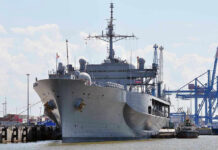
In multiple communiqués, Iran’s Islamic Revolutionary Guard Corps has framed its strikes on Bahrain, Kuwait, Qatar and other Gulf states as “punitive responses” to successive rounds of U.S. airstrikes on Iranian territory and assets near the Strait of Hormuz. The IRGC’s aerospace and navy branches have not been coy about their targeting logic: they explicitly list U.S. installations such as Ali Al Salem Air Base in Kuwait, the U.S. Fifth Fleet headquarters at Port Salman in Bahrain, and early warning and Patriot air-defense sites linked to U.S. forces in Qatar.
Iranian state and semi-official media reinforce that narrative. Reports tied to Nour News, Tasnim, and Fars describe coordinated ballistic missile and one-way drone operations against “U.S. bases in the region,” naming Al Udeid Air Base in Qatar, Ali Al Salem in Kuwait, Al Dhafra in the UAE, and the Fifth Fleet command in Bahrain as core targets. In separate statements, Iran’s army has claimed its drones hit a Patriot interceptor system in Kuwait, a satellite and early-warning facility in Qatar, and fuel storage used by U.S. forces in Bahrain, characterizing all of these as legitimate military objectives.
Tehran’s political framing is equally consistent. Iranian officials describe these operations as defensive retaliations under the rubric of self-defense in an ongoing conflict triggered by U.S. and Israeli strikes on Iranian nuclear, government, and coastal sites. In interviews and diplomatic messages, they stress that Iran harbors “no animosity” toward Gulf populations per se and insists its quarrel is with American power projection from Gulf soil.
What Gulf States Reported: Sirens, Interceptions, and Collateral Damage
The view from Manama, Kuwait City, and Doha is starkly different. Bahrain, Kuwait, Qatar and other Gulf governments describe the strikes first and foremost as violations of sovereignty—missiles and drones crossing their borders without consent and triggering civil defense procedures across dense urban areas. Residents received shelter-in-place alerts, sirens sounded over capital skylines, and airports and seaports halted operations while air defenses attempted to intercept incoming projectiles.
In some instances, local authorities report successful interception with no direct military damage. Kuwait’s defense ministry, for example, detailed how Iranian drones and two missiles were shot down shortly after U.S. strikes on Iran, with no injuries reported in that particular episode. CENTCOM similarly claimed its air and missile defenses thwarted attacks aimed at Bahrain and Kuwait, saying no U.S. personnel or assets were harmed.
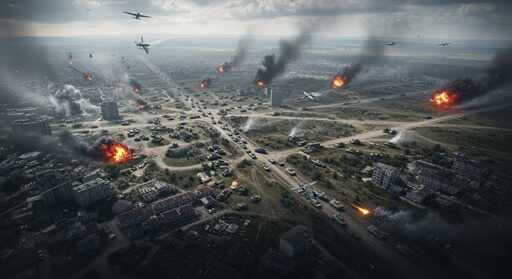
Yet across the broader campaign, the notion of “clean” military-only strikes does not hold. Kuwait’s international airport has been hit at least once by an Iranian drone, killing one person and injuring more than sixty, and disrupting flight operations. Bahraini authorities have reported damage to a residential building near the international airport following a drone strike, even in cases where no fatalities occurred. Qatar has acknowledged civilian casualties linked to shrapnel from regional military operations at sea, even when it did not specify Iran by name. Human rights organizations and investigative reporting add a wider lens: multiple Iranian strikes across GCC states have landed on or near hotels, civilian airports, energy plants, and residential areas, in ways that undercut Tehran’s claim of strict military targeting.
A Strategy of Asymmetric Retaliation: Why the Gulf, Not the U.S. Mainland
Iran’s decision to focus on U.S. assets in Bahrain, Kuwait, Qatar and other Gulf states rather than attempting to strike the continental United States is not improvisational; it reflects a strategic pattern developed over more than half a decade. Since early 2020, Iranian planners and IRGC aerospace units have repeatedly demonstrated medium-range ballistic and drone capabilities aimed at U.S. forward-operating bases—Al Udeid in Qatar, Ali Al Salem in Kuwait, Al Dhafra in the UAE, Prince Sultan in Saudi Arabia, and naval facilities in Bahrain among them.
The logic is twofold. First, these bases are the backbone of American military deployment in the Gulf—the infrastructure that enables air operations, maritime patrols, and rapid reinforcement of allies. Hitting them sends a direct message about Iran’s capacity to threaten the military architecture that underpins U.S. influence, without crossing the escalatory threshold associated with attacking U.S. soil. Second, operating in the Gulf’s crowded geography creates leverage: even minor disruptions at key airfields, ports, or energy facilities can ripple through global oil and gas markets and shipping routes, raising the economic and political cost of continued war.
Satellite imagery, independent verification by outlets such as BBC Verify, and broader conflict mapping suggest that this strategy has been sustained and extensive. Analyses indicate Iran has damaged or destroyed over two hundred structures and pieces of equipment at U.S.-linked installations across Qatar, Bahrain, the UAE, Kuwait and Jordan—hangars, fuel storage, radar and communications nodes among them. Brookings and other strategic studies note thousands of missiles and drones fired at land targets in the region, killing U.S. personnel and injuring hundreds, while also striking Gulf infrastructure.
Military Targeting Claims vs. Civilian Reality
On paper, Iran’s legal argument leans on international humanitarian law’s allowance to target military objectives in armed conflict. It presents U.S. bases, air-defense systems, and fuel depots servicing foreign forces as textbook examples. The difficulty lies not in the abstract definition but in the practical reality of firing ballistic missiles and one-way drones into or near densely populated Gulf cities and critical civilian infrastructure.
Independent human rights investigations and regional reporting describe a pattern in which declared military strikes regularly yield civilian harm. Amnesty International has documented Iranian drone attacks in Bahrain and Saudi Arabia that killed and injured civilians in residential areas, characterizing them as potential war crimes under the rules of distinction and proportionality. Human Rights Watch warns that Iran’s ongoing campaign places civilians in GCC countries at “grave risk,” with strikes reaching hotels, airports, and energy facilities well beyond strict military sites.
Regional media and think-tank monitoring similarly track Iran’s expansion from strictly base-centric targeting to attacks on energy terminals, desalination plants, airports, and transport links. Reports detail fuel tanks at Kuwait’s international airport and a desalination plant in Bahrain struck by Iranian missiles, with multiple deaths across the region. Coverage from Al Jazeera, CNN, and others notes an increasing focus on energy and civilian infrastructure—oil and gas facilities in Qatar and Saudi Arabia, steel plants designated as potential targets in several countries, and water and power assets used by both civilians and militaries.
Taken together, these strands of evidence show a tension at the core of Iran’s narrative. While Tehran consistently declares a military focus, the empirical record reveals frequent collateral—or, in some cases, apparently direct—hits on civilian objects. In the crowded geography of Gulf states that host U.S. bases, “dual-use” facilities and co-located infrastructure make clean separation between military and civilian targets exceedingly difficult, but that complexity does not erase legal responsibility when civilians are harmed.
Updates on Iran: Following the breakdown of the ceasefire/memorandum of understanding, fighting has escalated/resumed over the past 6 days (roughly July 13–17), with the US conducting multiple nights of strikes and Iran lashes out.
US (according to USCENTCOM) has conducted… https://t.co/yufEayVME2
— John Spencer (@SpencerGuard) July 17, 2026
How Gulf Hosts of U.S. Bases Are Politically Trapped
For Bahrain, Kuwait, Qatar and their neighbors, Iran’s strikes accentuate a long-standing strategic dilemma. Hosting U.S. military infrastructure brings security guarantees and political capital, but it also turns their territory into a proxy battlefield whenever U.S.–Iran tensions escalate. Every missile aimed “at the Americans” must physically traverse their airspace; every drone that impacts a base or is intercepted overhead does so above their cities and infrastructure.
In a joint statement, Qatar, Saudi Arabia, Bahrain, Jordan, Kuwait, the UAE and the United States condemned Iran’s attacks as “indiscriminate and reckless,” stressing that they targeted sovereign territory, endangered civilian populations, and damaged civilian infrastructure. Yet these governments are simultaneously managing domestic skepticism about their own choices: why host foreign bases that attract fire? Why should Gulf populations absorb risk and disruption for a conflict many see as driven by Washington and Tehran?
Opinion pieces and analysis from regional and international outlets point to growing discontent with the footprint of U.S. forces in the Middle East, especially after waves of Iranian retaliation. Iran itself seeks to exploit that sentiment; its foreign ministry has declared that countries hosting U.S. bases should “make them leave,” casting its strikes as pressure on local rulers to reconsider their alignment. The result is a politically delicate balance in Gulf capitals: public condemnation of Iran, private insistence that U.S. protection remains indispensable, and quiet exploration of ways to reduce exposure without severing ties.
What This Means Going Forward
The sequence of Iranian missile and drone attacks on Bahrain, Kuwait, Qatar and other Gulf states, and the explicit targeting of U.S. bases there, underscores how deeply U.S.–Iran confrontation is now embedded in Gulf security architecture. Iran has demonstrated that it can reach and damage key American installations and associated infrastructure; the United States, in turn, has shown it will strike inside Iran in response, further feeding Tehran’s retaliatory logic.
For Gulf states, the structural risk is unlikely to disappear soon. As long as U.S. forces remain deployed in significant numbers, these countries will sit at the intersection of deterrence and vulnerability. Their air defenses and civil protection systems can mitigate, but not eliminate, the danger of further barrages. Diplomatically, they will continue walking a tightrope: supporting U.S. operations enough to secure guarantees, while urging de-escalation to keep their cities from becoming permanent front lines.
For outside observers, the key is to separate Iran’s declared intent—to hit military targets from which attacks on its territory originate—from the observable outcomes, which include civilian casualties, infrastructure damage, and new questions about the legality and wisdom of using densely populated allied territory as staging grounds. The evidence from Bahrain, Kuwait, Qatar and their neighbors makes one reality clear: in this mode of asymmetric retaliation, there is no way to confine the consequences neatly within the perimeter of U.S. bases. The battlefield, and its risks, inevitably spill over into the everyday lives of Gulf civilians.
Sources:
insiderpaper.com, nypost.com, english.elpais.com, nytimes.com, aljazeera.com, pbs.org, reuters.com, youtube.com, middleeasteye.net, npr.org, hrw.org, theguardian.com, fdd.org, cnn.com, amnesty.org, bbc.com, alhurra.com, aa.com.tr, longwarjournal.org, taylortailored.co.uk, understandingwar.org, facebook.com, brookings.edu