
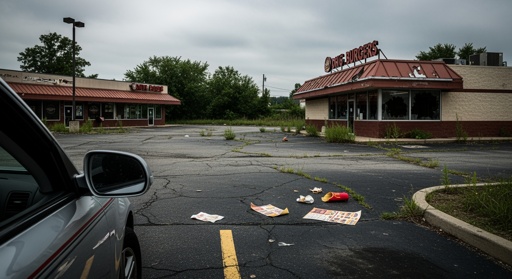
A franchisee’s financial collapse exposes how America’s struggling communities are losing basic services while corporate giants scramble to salvage what remains of their crumbling empire.
Franchise Failure Hits Nine States
ARC Burger LLC, a Marietta, Georgia-based Hardee’s franchisee, filed for Chapter 7 bankruptcy liquidation on April 20, 2026, triggering the immediate closure of 77 restaurants spanning Alabama, Florida, Georgia, Illinois, Kansas, Missouri, Montana, South Carolina, and Wyoming. The bankruptcy filing in the U.S. Bankruptcy Court for the Northern District of Georgia revealed over $29 million in total debt. Workers across these locations lost their jobs overnight, and communities—many in rural areas already underserved by dining options—suddenly found themselves without a familiar fast-food establishment that had served them for years.
Payment Defaults Trigger Corporate Lawsuit
ARC Burger’s financial troubles became apparent in December 2024 when the franchisee stopped paying the full range of obligations required under its franchise agreement, including royalties, advertising fees, technology fees, rent, and taxes. Hardee’s Restaurants LLC terminated ARC Burger’s franchise and sublease agreements in September 2025 but temporarily allowed operations to continue, likely to avoid the immediate costs of mass shutdowns. By November 21, 2025, Hardee’s filed a lawsuit in U.S. District Court for the Middle District of Tennessee seeking more than $6.5 million in unpaid fees. The legal action proved futile as ARC Burger ultimately threw in the towel with a Chapter 7 filing.
Two Bankruptcies in Three Years
The troubled history of these locations stretches back to 2023 when ARC Burger acquired 80 Hardee’s restaurants from Summit Restaurant Holdings, which itself had filed for Chapter 11 bankruptcy after closing 39 locations. ARC Burger took over these distressed assets hoping to turn them around, but the franchisee faced immediate financial strain that never improved. Before the bankruptcy filing, ARC had already shuttered three additional locations, leaving 77 operating when the final collapse came. This pattern reveals a harsh reality: these specific Hardee’s locations could not sustain a franchise operator under any circumstances. The franchise model’s demands—royalties, advertising contributions, technology fees—proved insurmountable for operators in markets that simply couldn’t generate sufficient revenue.
Corporate Takeover Salvages Some Locations
Hardee’s responded to the mass closures by announcing plans to assume ownership and resume operations at more than 40 of the recently shuttered locations, converting them from franchise-operated to corporate-owned stores. As of late April 2026, nearly two dozen restaurants had already reopened in Georgia, South Carolina, Mississippi, and Missouri, with hiring underway for additional staff. This corporate intervention highlights a growing trend in the fast-food industry where franchisors are reclaiming underperforming locations rather than allowing them to disappear entirely. While this move preserves some jobs and community access, it also signals a retreat from the franchise model in challenging markets. Corporate ownership typically involves higher operational costs, raising questions about long-term viability if these locations couldn’t support independent operators paying franchise fees.
Fast-food chain Hardee’s closing 77 restaurants across nine states https://t.co/fvYxjJZ80P
— ConservativeLibrarian (@ConserLibrarian) April 24, 2026
The broader implications extend beyond Hardee’s to the entire franchise restaurant industry. When the same locations fail under two different operators in three years despite different ownership and management, the problem isn’t just poor business execution—it points to fundamental economic weaknesses in the communities these restaurants serve. Rural and secondary markets in the Mountain West, Midwest, and Southeast are struggling with economic conditions that make even basic commercial operations difficult to sustain. The $29 million in debt now being liquidated will ripple through creditors and suppliers, many of whom are themselves small businesses. Meanwhile, displaced workers face unemployment in areas where job opportunities are already scarce, and residents lose convenient dining options that won’t easily be replaced.
Sources:
Hardee’s Closed 77 Locations After A Franchisee Stopped Paying Its Bills In December
Hardee’s Franchisee Files For Bankruptcy After Dramatic Closures