
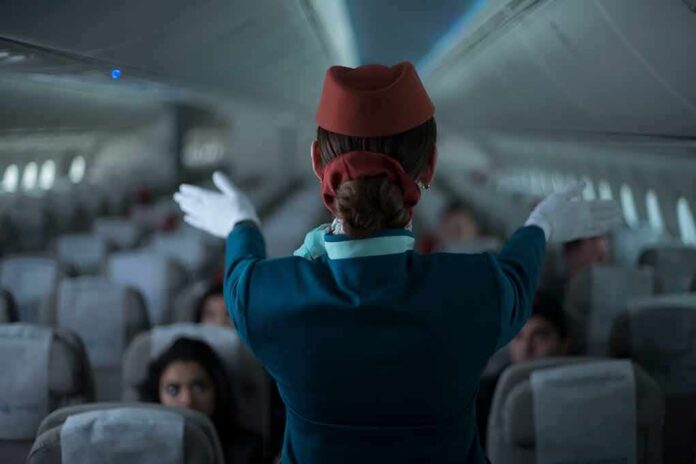
A midair clash over “Sharia law” on a Turkey–Germany flight is reigniting fears that elites are letting ideology and extremism trump basic safety and common sense.
Story Snapshot
- A 29-year-old man allegedly refused to sit next to a woman, citing Sharia law, then struck a female flight attendant.
- German police say he confessed after landing and now faces assault and insult charges under German law.
- The case exposes growing tension between religious claims, women’s rights, and public safety in Europe.
- Confusion over airline details and social media spin add to public distrust of institutions and media.
What Police Say Happened On The Flight
German media and police reports say a 29-year-old man on a flight from Turkey to Düsseldorf refused to stay in his assigned seat because he did not want to sit next to a woman. Witnesses told police he “invoked Sharia law” as his reason, using Islam’s moral code to claim that sitting beside a woman was not acceptable for him. When a female flight attendant tried to deal with the situation and calm him down, he allegedly punched or slapped her in the face in front of other passengers. The plane continued to Düsseldorf without diversion, but federal police boarded as soon as it landed and took the man into custody for questioning.
Police in Düsseldorf say the suspect, described as a German citizen or resident with Turkish roots, admitted to attacking the flight attendant during his first interview after landing. Reports also say he insulted officers in Turkish, not realizing one of them understood the language, which led to an extra charge for insulting police in addition to the assault count. Authorities have opened a case for intentional bodily harm, similar to a battery charge, and passed it from federal police at the airport to the local Düsseldorf Police Department for longer-term investigation. So far, officials have not released the suspect’s name, the crew member’s name, or full medical details about her injuries.
Religious Claims Versus The Law And Women’s Safety
German police and major outlets are clear on one point: Sharia law has no legal standing in Germany. That means any personal religious claim cannot override safety rules, airline policies, or national law on a commercial flight. The man’s refusal to sit next to a woman raised basic questions about women’s freedom to travel, work, and move about in public without facing discrimination or aggression from seatmates. The flight attendant was simply doing her job, enforcing safety rules and trying to resolve a seating dispute, when she was allegedly struck. Experts and reporters note that airlines will often honor respectful seating requests when possible, but they stress that violence and refusal to obey crew instructions cross a clear legal line that no democratic system can accept.
This case also sits in a wider pattern where a small number of passengers in Western countries have used religious or cultural reasons to avoid sitting near women. These incidents are still rare but draw strong attention because they pit personal belief against basic norms of equality in public spaces. In Germany, officials track crimes tied to religious or political ideologies, and they have seen hundreds of offences linked to Islamist motives in recent years. At the same time, German and European reports show many attacks on religious minorities, including Muslims, making clear that imported tensions can feed backlash and fuel a cycle of fear and anger. For ordinary travelers, the common worry is simpler: they want to board a plane without becoming part of someone else’s ideological fight.
Media Confusion, Social Anger, And Deep-State Distrust
Coverage of the case has not been perfect, which is adding to distrust. Early reports claimed the flight was run by Turkish Airlines, but the company later told reporters the incident did not happen on one of its planes and was “unrelated” to the airline. Some outlets then walked back or corrected that detail, while others kept older versions alive online. Social media posts and small video channels rushed to share clips and headlines about “Sharia law on a German flight,” feeding strong reactions on both the left and the right. Many users framed the story as proof that officials are losing control of borders, failing to demand assimilation, or hiding details to protect certain groups, all of which deepen suspicion toward what people call “the elites” or “the deep state.”
German police arrested a passenger after he allegedly refused to sit next to a woman on a flight, reportedly claiming that doing so would violate his interpretation of Sharia law. ‼️Authorities say that when a female flight attendant tried to resolve the situation, the man… pic.twitter.com/To9WsHICfZ
— Jade Warwick (@TheJadeWarwick) July 20, 2026
The facts that are firm so far are narrower than the online anger: a man cited Sharia law, refused a seat next to a woman, struck a crew member, and then confessed; German police are treating it as a criminal assault and an insult case under German law. Still, the story hits nerves that go beyond one flight. Many conservatives see it as another sign that Western leaders are too soft on extremism, too willing to bend public rules to please activists, and too slow to defend women’s rights and security. Many liberals see it as proof that systems are failing to protect both women and peaceful religious minorities at the same time, instead letting tensions build until something goes wrong. People across the spectrum share a darker worry: they fear a government and media class more focused on managing narratives than solving the hard problems around migration, culture clashes, and public safety. When a simple seating dispute turns into a violent clash over religious law at 30,000 feet, it feels less like a random event and more like another warning light on a dashboard that leaders keep ignoring.
Sources:
thegatewaypundit.com, abcnews4.com, newsbreak.com, instagram.com, en.wikipedia.org, youtube.com