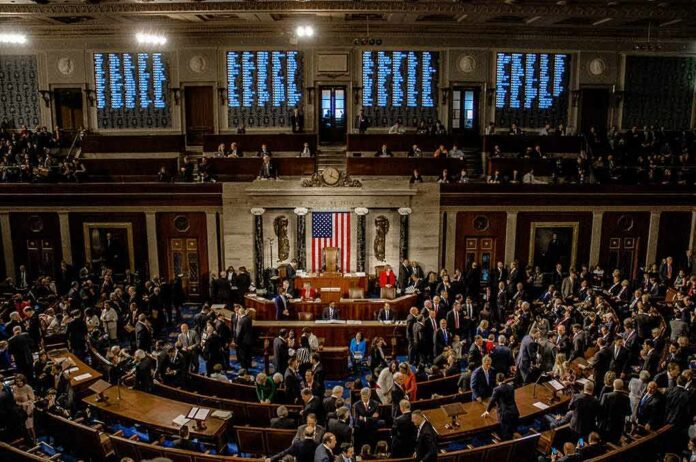
A sitting congresswoman says declassified files will soon show foreign government agents planted inside congressional offices as “interns” while leaders admit there are no background checks for the people handling some of the nation’s most sensitive information.
Story Snapshot
- Rep. Anna Paulina Luna claims upcoming declassified records will expose foreign spies placed as congressional interns by a former member of Congress.
- Rep. Kat Cammack backs Laura Loomer’s report that the foreign government involved is Qatar, a major player in Washington influence campaigns.
- Cammack says congressional staff and interns undergo no mandatory background checks even when they see classified information.
- These explosive claims remain unverified, but they highlight real gaps in security and growing fears that foreign money and influence have captured Congress.
Allegations of Foreign Agents Hiding in Congressional Internships
Rep. Anna Paulina Luna of Florida told followers that “seriously disturbing” declassified files are set to be released that will show a former member of Congress placing interns in other congressional offices who were actually agents of foreign governments. She called the episode a “massive security breach” and urged House leaders to act, saying these interns were able to move quietly inside the Capitol under friendly cover. So far, she has not named the former member or any specific offices involved, and no documents have been made public.
Investigative journalist Laura Loomer then tied Luna’s warning to her own prior reporting that the government of Qatar had placed foreign agents inside congressional offices while calling them interns. Florida Rep. Kat Cammack replied to Loomer, “You would be correct,” confirming that Qatar is the country she believes is at the center of the scheme. The Gateway Pundit report summarizing these claims describes Qatar as a hostile government that has “been operating inside the halls of Congress with almost zero scrutiny,” though it offers no names, dates, or official records to support that level of detail.
How Congressional Staff Can Access Sensitive Information Without Checks
Rep. Cammack says the most shocking part of this story is not only the foreign agents claim but the basic staffing rules inside Congress. In her written statement, she told Americans, “You read that right. There are NO background checks for Congressional staff.” That means many congressional staffers and interns, who often read briefing papers, attend classified sessions with members, or handle sensitive communications, may never go through any formal screening for criminal history, foreign ties, or security risks. Cammack calls this gap an “insane vulnerability” in a building that sets the nation’s laws.
To address this, Cammack introduced House Resolution 500 in June 2025, which would require criminal background checks carried out by the United States Capitol Police for all House employees and require staff to fully disclose dual citizenship and work or financial ties with foreign nations. Her push does not come out of nowhere. For years, watchdogs have warned that foreign influence creeps into Congress through lobbyists, think tanks, and former officials who later work for foreign governments. But staff and interns inside congressional offices often sit outside key laws like the Foreign Agents Registration Act, which focuses mainly on lobbyists and public advocates, not day-to-day aides.
Qatar’s Deep Footprint in Washington Raises the Stakes
The claims about Qatar land in a context where that country is already known for spending big to shape United States policy. Research from the Quincy Institute shows Qatar secures more in-person meetings with United States officials than any other country in part by hiring well-connected lobbyists, including at least three former members of Congress who registered as foreign agents for Qatar. Separate reporting finds Qatari foreign agents have donated nearly $700,000 to members of Congress and other officials since 2020, often while lobbying the same offices they were bankrolling.
Other public records show that Qatari soft power reaches far beyond Congress itself. Data reported by OpenSecrets and others indicate foreign agents for Qatar have contacted more than two-thirds of all members of Congress in recent years. Meanwhile, the United States Department of Education reports that Qatar has become the largest foreign source of money to American colleges and universities, with about $6.6 billion in gifts and contracts. For many Americans on both the right and the left, this kind of spending looks like a slow-motion takeover of key institutions, feeding anger at a political class that seems more responsive to foreign cash than to ordinary citizens.
Big Questions, Thin Evidence, and a Deep Trust Problem
For now, Luna’s most explosive claims remain unproven. She says declassified files “will be coming out in the coming weeks,” but as of mid-July 2026, there are no public documents that identify the former member of Congress she accuses or any specific intern. There are no court filings, no official House reports, and no named witnesses on record. Mainstream outlets such as the Associated Press, Reuters, and major television networks have not confirmed the story, leaving coverage mainly to ideologically driven sites and social media.
🚨 BREAKING: Rep. Anna Paulina Luna says documents will be declassified showing Qatari foreign agents are serving as interns for unnamed Congress members. pic.twitter.com/vr9JihWDVu
— Discourse News (@Discourse__News) July 21, 2026
Luna’s own record adds to public doubts. Mother Jones reports that she has held a hearing on Central Intelligence Agency “mind control” and strongly promoted theories about MKUltra, the John F. Kennedy assassination files, and the origins of COVID, framing them as part of a broader plot by the deep state. Other outlets note she previously claimed the Central Intelligence Agency “raided” an intelligence office linked to Tulsi Gabbard, a charge that officials flatly denied and that she later moderated. Supporters see her as fearless against secret government power; critics see a pattern of dramatic claims not backed by hard evidence.
Why This Story Resonates With a Country Losing Faith in Its Leaders
This dispute hits a nerve because it matches what many Americans already fear: that the federal government is wide open to foreign influence while everyday citizens are locked out of real power. Long before Luna’s posts, researchers warned that former members of Congress and top aides were cashing in by working for foreign governments, sometimes using leftover campaign funds to boost their new clients. The law meant to control this, the Foreign Agents Registration Act, mainly forces public disclosure by foreign lobbyists and public relations firms, not by the junior staff in congressional offices who help shape the daily flow of information.
Whether Luna’s promised documents confirm her claims or not, the basic facts already on record show a system that invites distrust. Foreign governments like Qatar can pour millions into lobbying, media, and universities. Former officials can sign up as foreign agents soon after leaving office. Congressional staff and interns can work around sensitive information with no required background checks. Meanwhile, ordinary Americans watch fights between parties and hear competing accusations of “conspiracy” and “cover-up,” but rarely see simple reforms that would close obvious loopholes.
Sources:
thegatewaypundit.com, redstate.com, youtube.com, oversight.house.gov, facebook.com, motherjones.com, hindustantimes.com, newsnationnow.com, freebeacon.com