
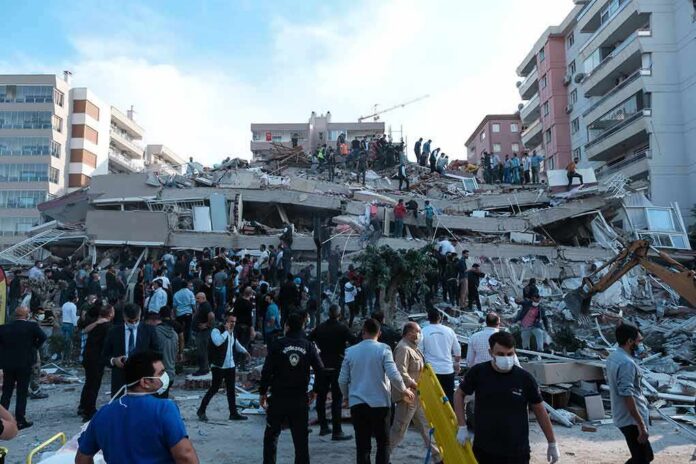
As Venezuela’s shattered cities dig out from twin mega-quakes, the Red Cross warns the real struggle will last for years, not days.
Story Snapshot
- Two powerful earthquakes on June 24 turned parts of northern Venezuela into rubble and left thousands dead.
- Relief agencies say the country faces a long humanitarian emergency and that full recovery will take years.
- Key hospitals, water systems, and tens of thousands of homes were destroyed, pushing many families into deep poverty.
- Global aid is flowing in, but there are signs the world could move on long before Venezuelans are back on their feet.
Twin earthquakes and a country in ruins
On June 24, two huge earthquakes, measured at magnitudes 7.2 and 7.5, struck central and northern Venezuela less than a minute apart, making the second tremor the strongest recorded there since 1900. The shocks collapsed buildings across coastal La Guaira state, the capital district around Caracas, and several inland regions, turning entire neighborhoods into piles of concrete and twisted metal. Early rescue reports spoke of hundreds dead, but officials quickly warned that deaths could reach into the thousands.
As search teams worked through the rubble, the human toll kept rising. Venezuela’s National Assembly president Jorge Rodríguez later confirmed at least 3,811 deaths and 16,740 injuries, with nearly 18,000 people left homeless. United Nations estimates suggest the true death toll could be even higher, with tens of thousands missing in the first week and satellite radar data showing damage or destruction to around 58,000 structures. United States Geological Survey models pointed to economic losses in the billions or even tens of billions of dollars.
From rescue to a long, grinding recovery
During the first week after the quakes, rescue efforts dominated headlines as Venezuelan teams and nearly 2,000 specialists from 27 countries raced to find survivors, sometimes pulling people out days after the disaster. United Nations officials described a “major humanitarian emergency” and stressed that recovery “is going to take time,” signaling that this was not a quick rebuild but a deep, long-term crisis. The International Organization for Migration warned that up to 6.8 million people could be affected and in need of shelter, water, health care, and basic supplies.
The International Federation of Red Cross and Red Crescent Societies has joined other relief organizations in telling donors and governments that Venezuela’s recovery will take years and that aid cannot stop once television cameras leave. Aid groups report damage to more than 2,500 key infrastructure sites, including 38 hospitals, which has crippled access to health services, safe water, and sanitation. United Nations estimates place direct damage at between 4.7 and 8.7 billion U.S. dollars, about 4 to 8 percent of Venezuela’s yearly economic output, and say true costs could be up to three times higher.
How the disaster feeds wider anger at broken systems
International partners, including the United States, the United Kingdom, Brazil, Chile, China, India, Japan, Turkey, and others, have sent search teams, medical units, and millions in emergency funding. Venezuela’s interim leadership announced an initial 200 million dollar reconstruction fund, drawn from global lenders, to repair homes and hospitals. Still, there is a gap between big promises and what families in destroyed neighborhoods actually see. Some Caracas residents told reporters that no help had reached them even days after the quakes, forcing them to dig for loved ones with their bare hands.
For many Americans watching from afar, this story hits close to home. People on the right and the left already worry that elites cut deals at global conferences while regular families fight to afford housing, clean water, and energy. Social media posts have noted that billionaires were striking business deals the same week Venezuela moved from rescue to long-term recovery, feeding the feeling that the rich live in a different world than disaster victims. The slow pace of rebuilding in Venezuela fits a pattern seen after other disasters, where the poorest wait the longest to get back even a basic home.
Why “years of recovery” should concern everyone
When the Red Cross says Venezuela’s recovery will take years, it is not just talking about pouring concrete or raising new apartment blocks. Long recoveries often mean families living for years in tents or crowded shelters, kids missing school because classrooms are gone, and sick people traveling long distances because nearby clinics were never rebuilt. That kind of slow-motion crisis deepens inequality and can push whole communities out of the middle class and into permanent poverty.
🇮🇱🇻🇪 Israel’s aid delegation completes mission in Venezuela; meets interim president Delcy Rodríguez
“Venezuela’s interim president, Delcy Rodríguez, held a meeting today to thank the joint Israeli aid delegation from the Foreign Ministry and the IDF following the completion of… pic.twitter.com/3vOvUWyJHB
— גיא עזריאל Guy Azriel (@GuyAz) July 22, 2026
This is also a warning about how fragile basic systems have become worldwide. In Venezuela, weak infrastructure, aging buildings, and political and economic troubles made the earthquakes far more deadly and costly. Many Americans see similar red flags at home when bridges, power grids, and water systems fail during storms or heat waves. The Venezuelan disaster shows what happens when those warning signs are ignored year after year. It raises a hard question for every government, including Washington: are leaders more focused on short-term politics than on building strong systems that can survive the next major shock?
Sources:
insiderpaper.com, news.un.org, cnn.com, npr.org, marca.com, theguardian.com, unfpa.org, en.wikipedia.org, youtube.com, reuters.com, earthquake.usgs.gov